a note about this story!!!
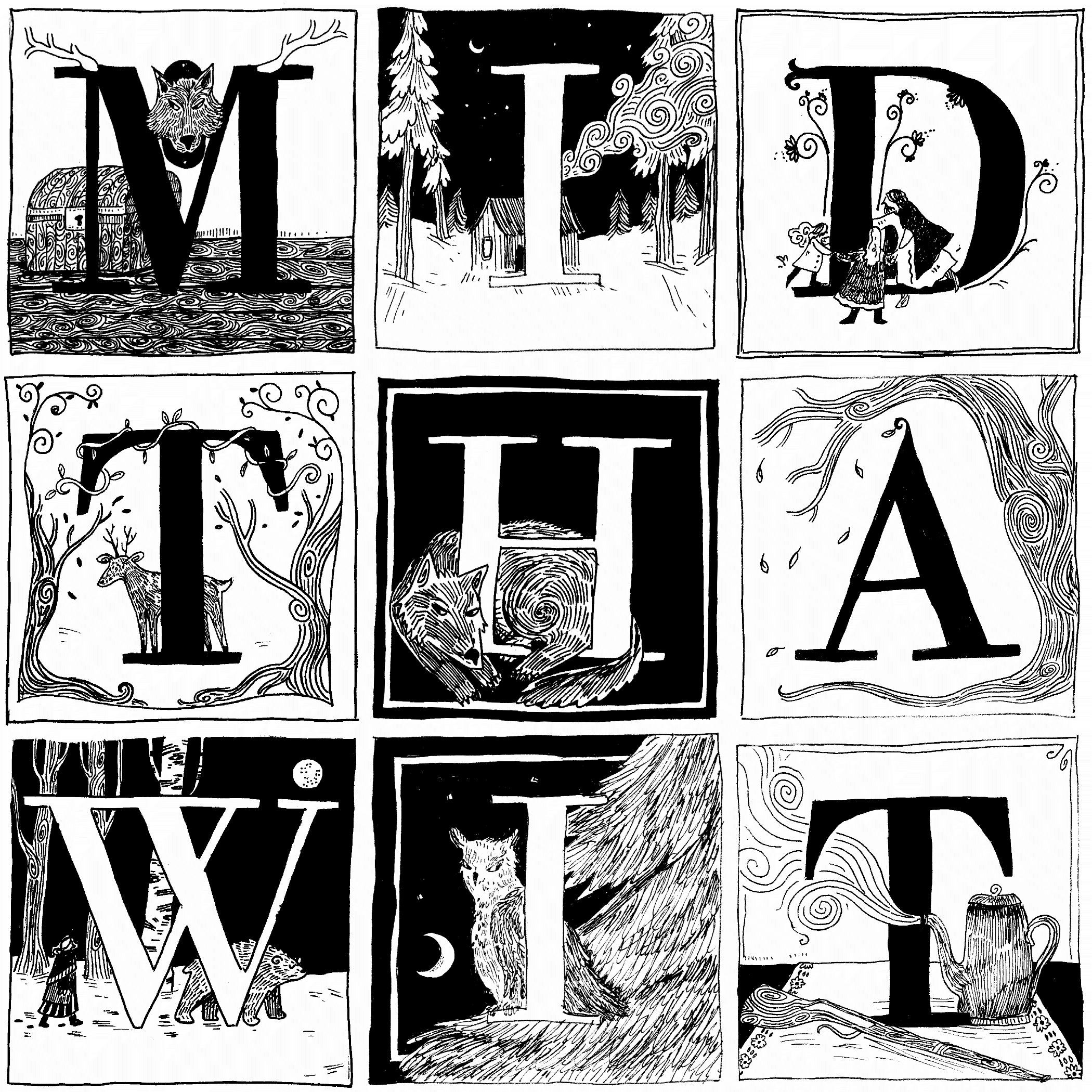
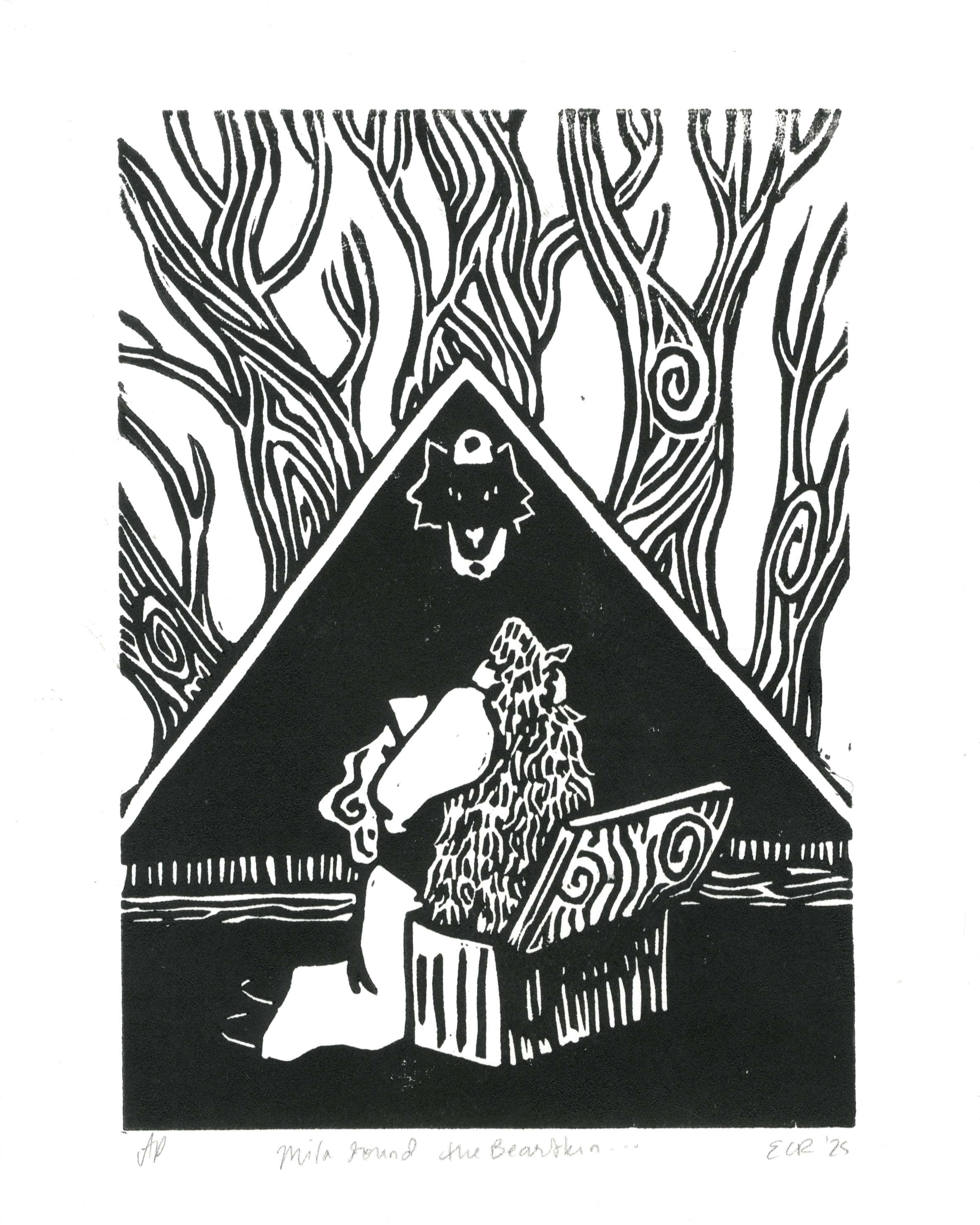
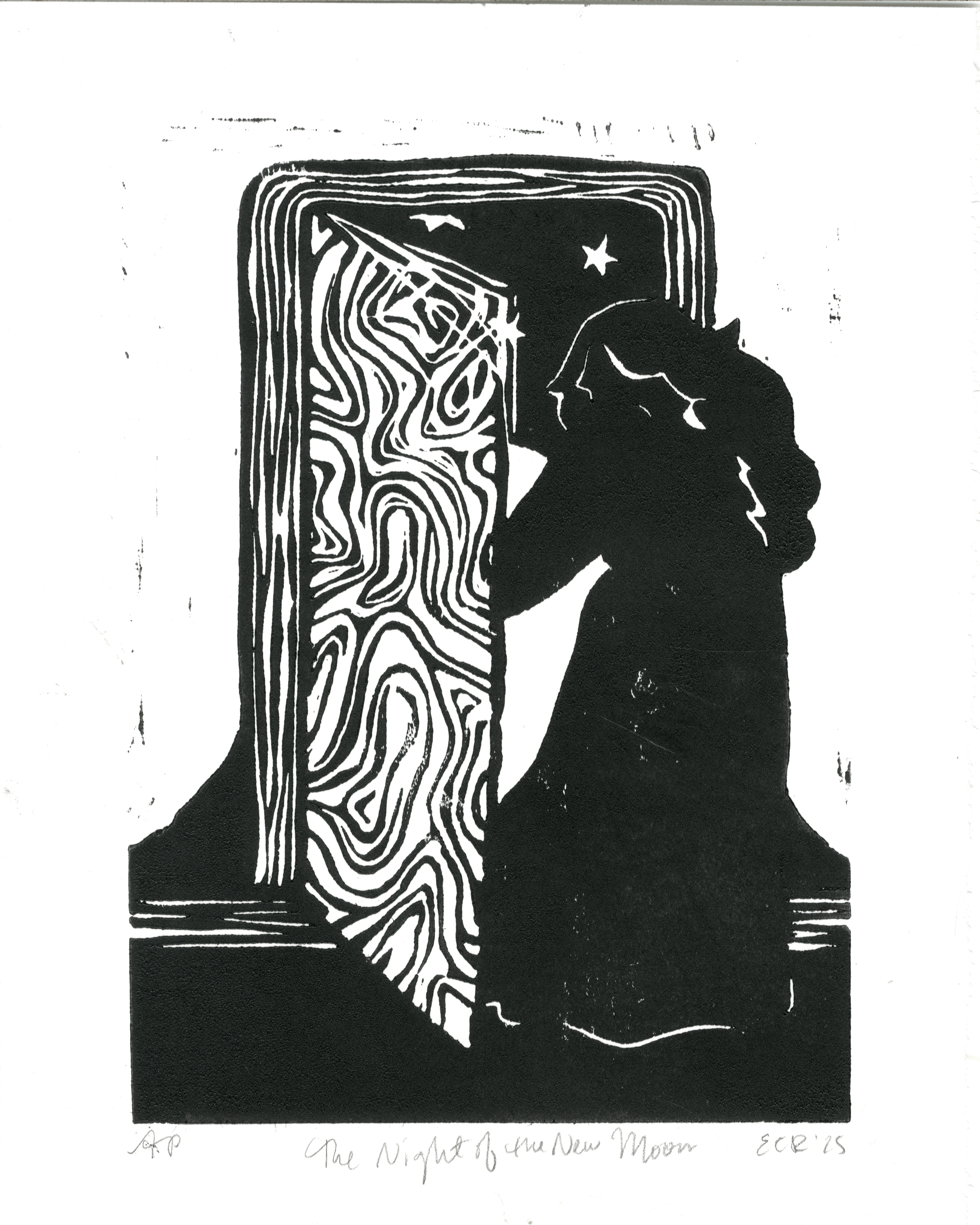
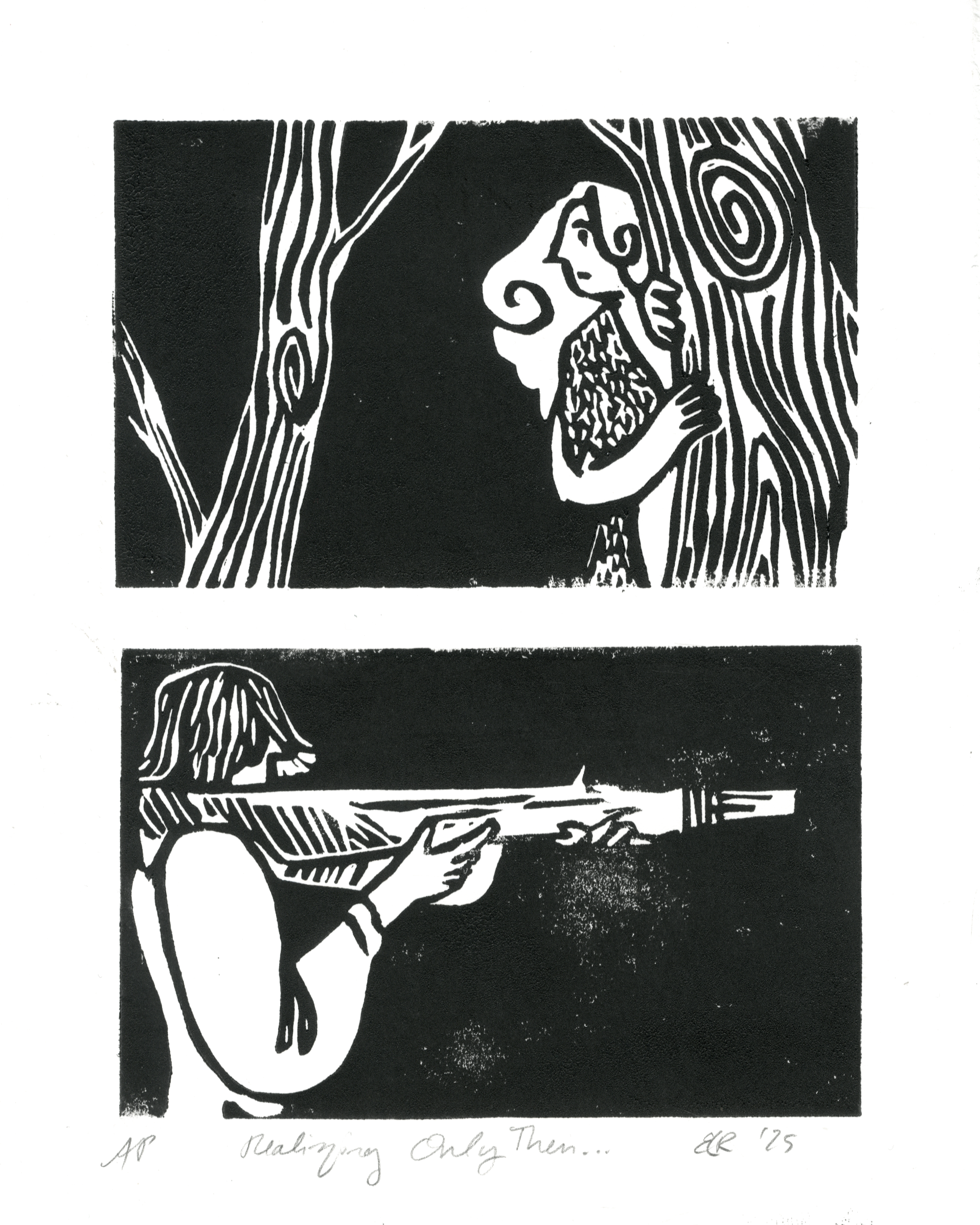
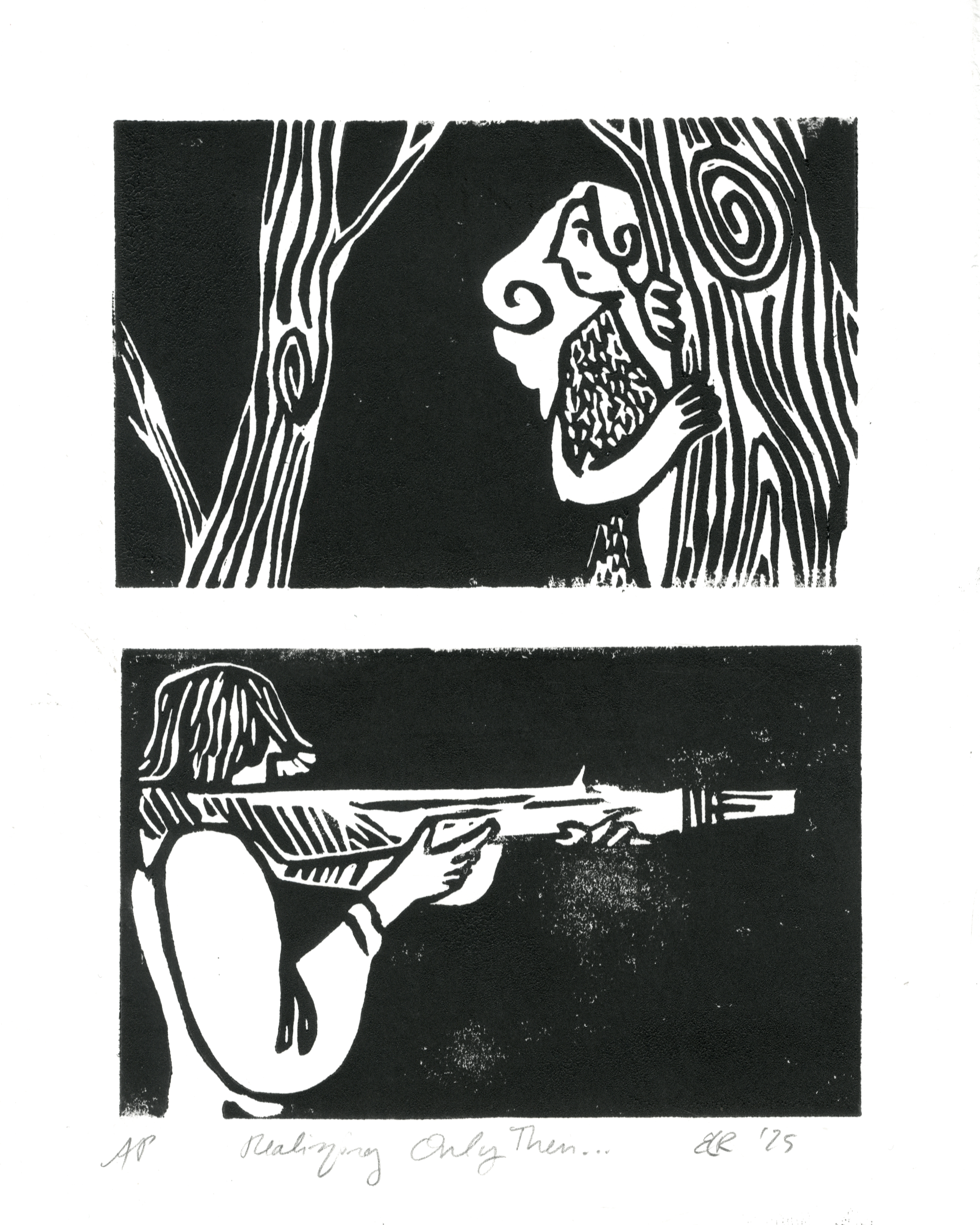
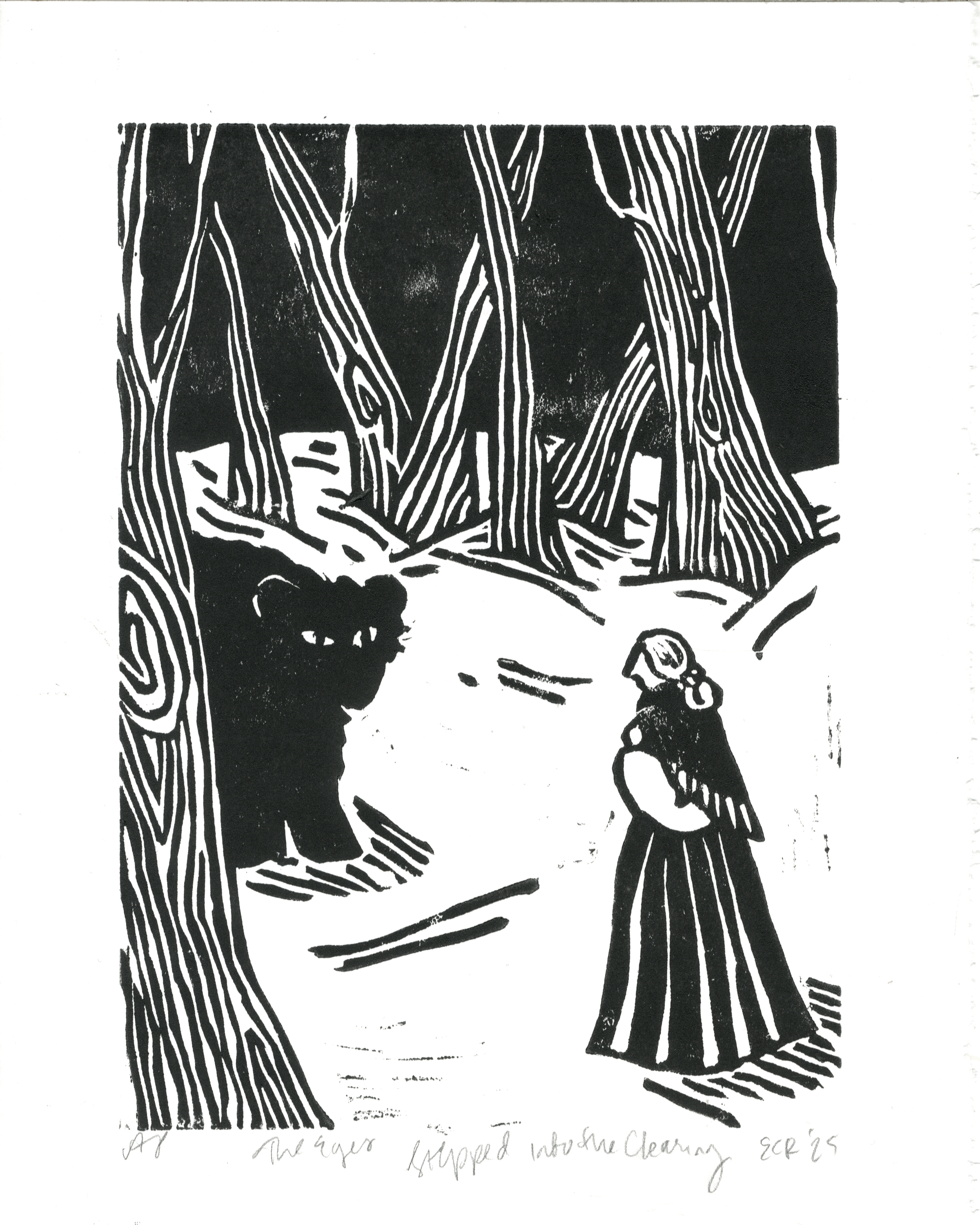
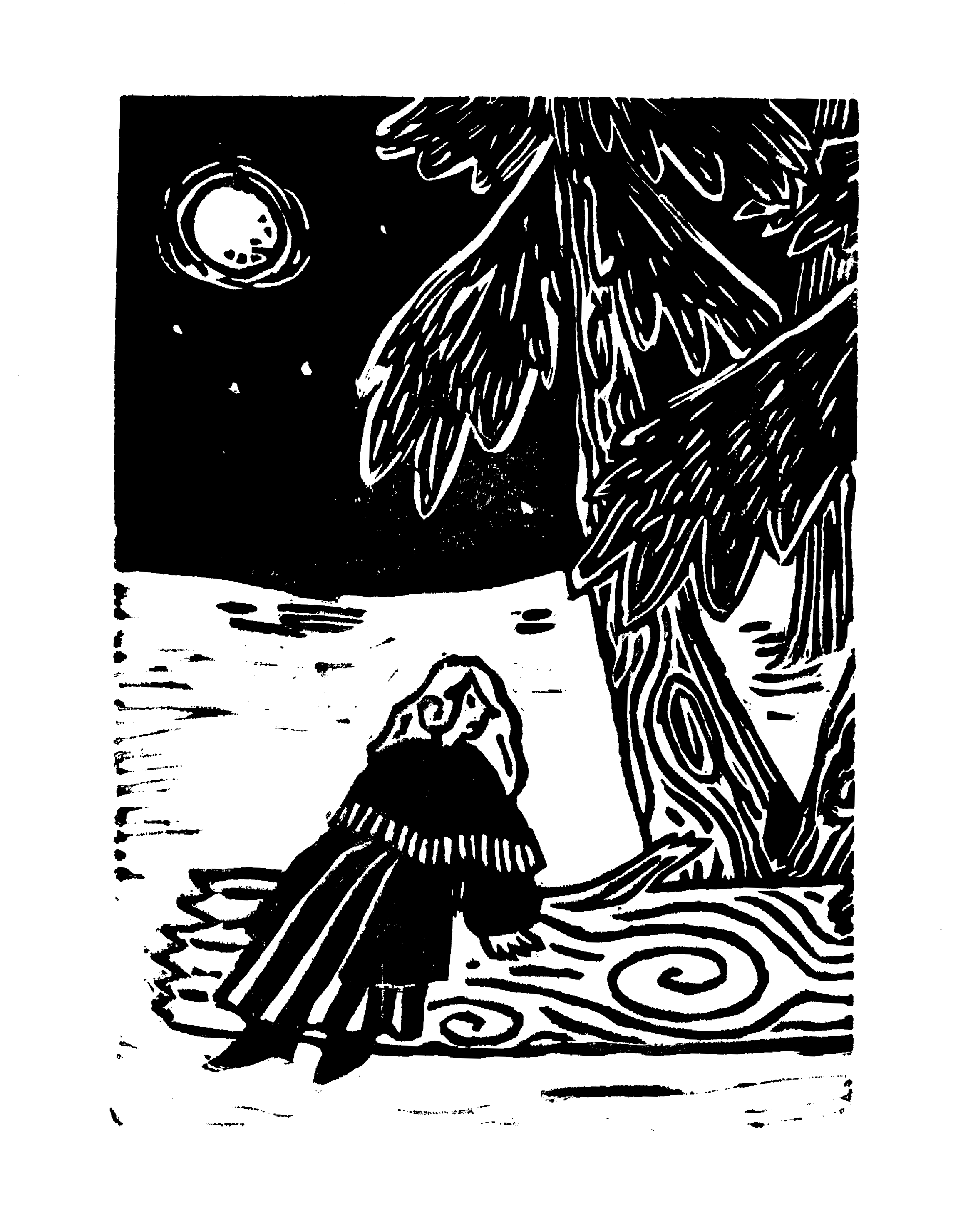
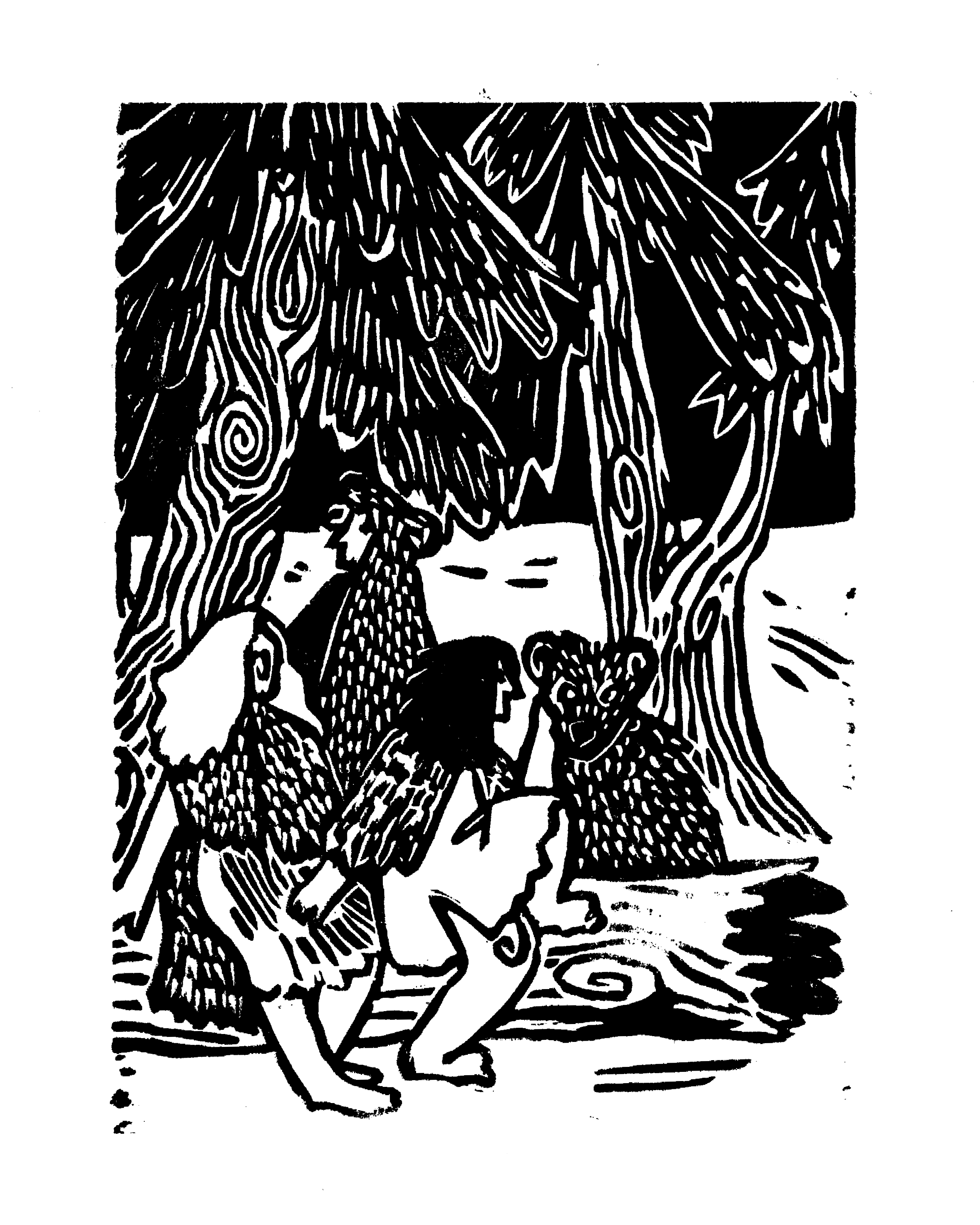
if you've read this story before today (may 7, 2026), I recommend checking it out again! I rewrote it twice recently and this is the final product, with a vastly different ending than the original. additionally, I bound and illustrated this version into a little book for my senior capstone for my bachelor's degree! the eight images below are the linocut prints i made to illustrate this, and at the end of the story you can find nine decorative capitals I designed to mark sections in the story as well as the first sketch I made for what ultimately became illustration #1! as always, you can click on an image to see it larger. anyway, enjoy :)
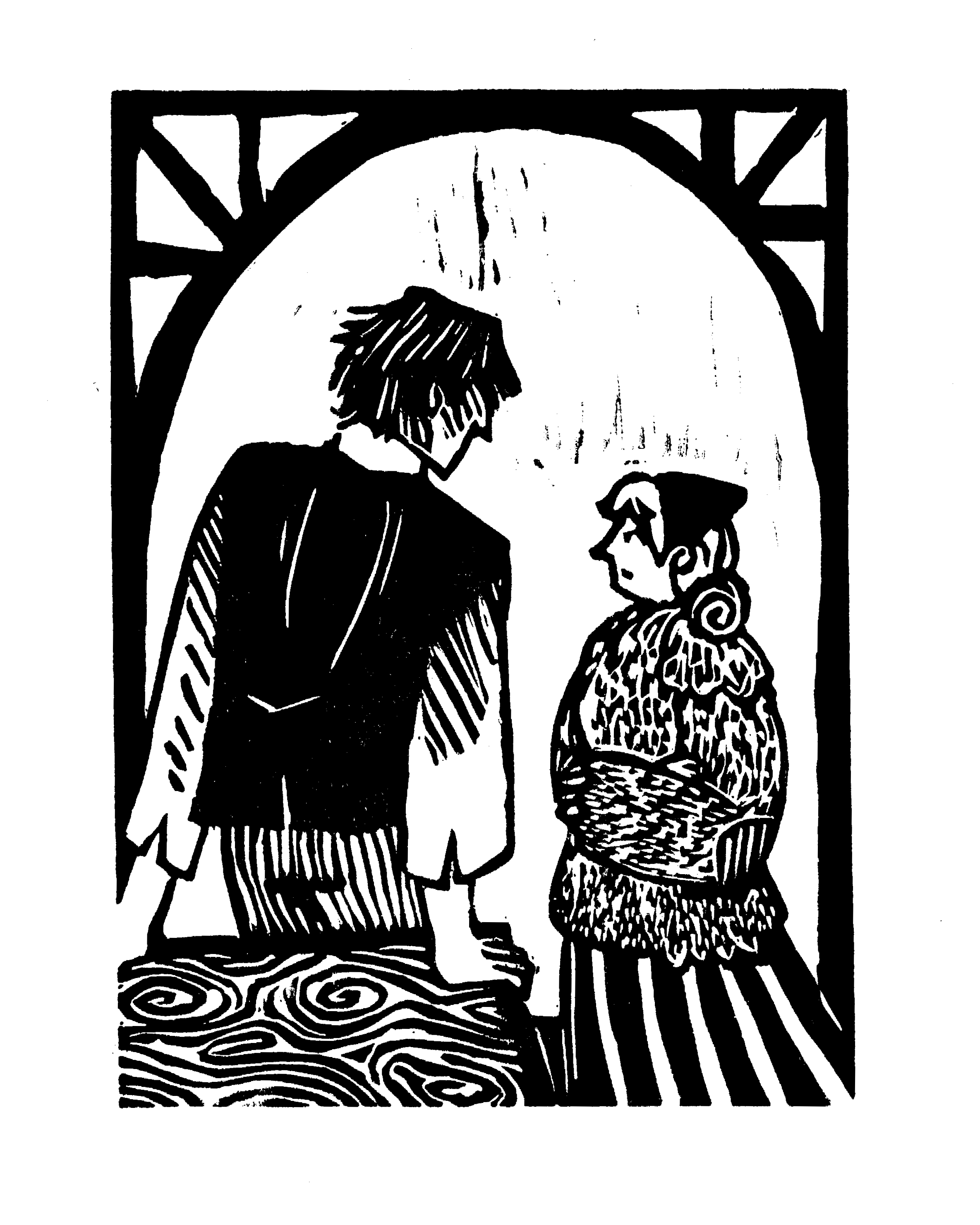
Bearskin
Mila found the bearskin when she should have been cleaning the attic. One of her father's old trunks, where he kept his hunting supplies, was unlatched, and she thought, Might as well dust the guns too. When she pulled out the dusty skin, its fur was far softer than she'd imagined. Her fingers sank into the brown fur as though it was loamy dirt, fluffed and waiting. It seemed to crackle with an impending shock. She dropped it back into the trunk, unfolded and disarrayed, and let the lid slam shut. Best not to be distracted, she thought, feeling the glass eyes of the mounted wolf-head on the wall watching her. You'll never marry if you can't clean a simple room. She pushed the trunk back to the wall. When she lifted her rag to return to dusting, she found a splinter buried, like a claw, in the pad of her thumb.
Two weeks later, when the moon was dark and the winter sky lit only by stars, Mila woke in the middle of the night. The fire had fallen to crackling embers and the world outside her wool blanket was a sharp, cold thing. From her pallet on the floor she saw a figure move silently, deliberately, to the door. The latch squeaked and the figure froze. As it pulled the door open, letting in a snowy gust of wind, Mila caught a glimpse of yellow eyes flashing in the night. Her mother held a finger to her lips, then disappeared.
Mila couldn't get back to sleep after that. Maybe her mother's leaving was just a dream, but that didn't account for the roars she heard that night amidst the whistling wind, the splintering of wood, the strange crashing in the forest. All noises that were a far cry from the usual winter silence.
In the morning, her mother was gone. Her father sent Ivan out to look for her, but a fresh snow had fallen, and the wind had shifted her footsteps into nothing. What the wind could not hide was the ruins of the shed. Her father's favorite rifle lay in two twisted and splintered pieces on the dirt floor. The door was shredded, strips of wood strewn all around. And all the salted meat that should have hung from the rafters was gone.
Mila, her brother, and her father stood in the snow staring at the carnage. Mila knew then that she would never see her mother again.
Her father fell ill not long after that, and all the years of Mila's young adolescence, when she should have been embroidering napkins for a dowry or learning to braid her hair like a married woman's, we spent tending to him instead. She should have been meeting the sons of hunters, of farmers, maybe of tradesmen if she was lucky. Instead she stayed home, boiling her father's bedsheets with lye because he'd soiled them again. "What will I do with you?" her father asked her once, as she boiled chicken bones into a thin broth, as though it was her own fault she could not trudge to town on errands to meet young men herself, as though she had chosen the path of spinsterhood at the ripe age of fifteen. This should have been her mother's job. Whenever Mila couldn't get out a stain, or she realized she hadn't left the house in three days, or she stood over yet another pot of broth, she cursed her mother for running away and not taking Mila with her.
Her father did not die peacefully in his sleep. His body got weaker and cough got stronger. Mila had to clean his bedpans, had to learn to change sheets while a body still lay atop them. He died one day during a coughing fit that was simply too much for his body. Mila was out of the room washing up. She heard the coughs but, in a moment of bitterness that led to paralysis, did not go running. She dropped her sponge and pillowcase into her bucket, let the washboard slide down, and listened to her father's last breaths. When the coughing stopped, she went to check on him. He was dead.
Not long after this, Ivan brought home a pretty girl a couple years older than Mila. Her blonde hair was immaculately braided and her rosy smile seemed to symbolize everything wrong with Mila, who had never learned which of a man's words you laughed at and which you nodded silently to. When Irina gave birth to twin girls as rosy and beautiful as herself, Mila moved to the attic, feeling every bit the spinster, and realized she would never have the chance to be anyone else.
In the attic again, Mila pushed aside old splintering trunks to make room for her tick mattress. She pulled the curtains off the windows to let in some light. She finally took her father's old trophy, that wolf-head, off the wall so that its glass eyes would not watch her as she slept. The chest she unlatched to toss it into seemed empty -- it was where she had found that bearskin all those years ago, before her mother disappeared. The mounted head landed in the trunk not with a clatter but with a dull, muffled thud. She knelt down to look at the contents of the trunk and found a second bearskin. This one seemed to crawl up her arm without her doing a thing. It did not shock her, or crackle, but felt like melting into the shade on a summer's day, like a spoonful of honey on a sore throat, like waking up to sunlight streaming in through the windows. In short, it felt good. She shook it off in shock and let it slump back into a dusty pile at the bottom of the trunk. Her hands that had touched the skin felt suddenly exposed, naked, like their skin had been ripped away and her insides were exposed to the world.
That evening, while Irina tended to the girls, Mila made stew. "You're such a blessing," said Irina. "I don't know what we'd do without you."
You'd cook like any other wife, thought Mila. You should be here now, bent over the fire and I am, but I should be far away in the arms of an unknown man. "I'm sure you'd get by," she said instead with a laugh. "Everyone else does." Though she laughed, Mila felt like her hands were the wrong shape as they grasped the knife, as they stirred the pot. Her skin was so soft and tender. The hair on her arms was so thin.
They sat together round the wooden table when Ivan came in. A bowl of soup laid for each of them, even the girls, who could hardly hold spoons. They ate in silence till Ivan said, "The meat's a touch underdone."
Mila hadn't noticed. "I think it tastes perfect." Though now that he mentioned it, she could feel the coppery aftertaste of blood. She didn't dislike it.
Ivan put his half-finished bowl on the ground for the dog, who devoured it ravenously. Mila watched it out of the corner of her eye, burning with jealousy she would never speak aloud.
"Do say you'll stay with us forever, Mila," said Irina. "Spare us the trouble of all that extra work. And spare yourself the trouble of the married life. It isn't nearly all it's cracked up to be, I'll tell you that."
Mila scrubbed one of the girl's diapers with bleach in the boiling washwater. Spare you the trouble, more like, she thought, the trouble of handling your own household. She said, "How can I say such a thing? You never know -- a handsome stranger may show up at the door any day." Irina laughed as though Mila was joking. Mila turned back to the diaper, the bleach, her raw red hands. The roughness and callouses from washing were the only things that made them feel solid anymore. Ever since she'd opened that trunk, she'd felt like her body was on the verge of blowing away, of being torn to shreds by the slightest wind. The pain in her hands grounded her. The skin hasn't ripped from all this. Who's to say it ever will?
Irina tossed one of the girls in the air. Mila scrubbed harder to tune out their delighted cries. How had she found herself here? She hardly knew anyone in town, had never had the chance to meet anyone, to become herself. She would forever be a shadow. She thought, not for the first time, of the bearskin in the attic. Of her mother's disappearance, the shredded shed door. She thought of old stories her mother had told her long ago: birds who turned into women, men who became wolves. And so perhaps too there could be a woman who was also a bear.
She had said this once to Ivan, years and years ago, right after their mother left.
"It's just a story, Mila," he'd said. He was sixteen. He was a boy. His word was law. "And besides, she's probably lying under some other man as we speak."
Mila had cried, told him he was lying.
He held her and said, "It doesn't matter where she's gone, Mila, only that she's not here anymore."
That was the only time he'd ever reacted to their mother's vanishing.
That night, Mila opened the trunk for the first time in months. She stroked the soft fur and imagined its warmth enveloping her. The feeling of the soft ground beneath her bare feet. Standing in the river with a trout in her mouth. Her life beholden only to her desires, no longer confined by her brother's will.
Before she had a chance to change her mind, she pulled the skin from the trunk. Like her mother so many years before, she crept down the attic ladder and through the kitchen, carefully stepping around her nieces' cots. She unlatched the door. Her breath caught in her throat when it squeaked, just the way her mother's had. She stepped out into the night -- a full moon this time, and spring -- and let the door swing shut behind herself.
Mila left the shed and house intact. There was no point destroying them. How caring she was! How unlike her mother! This is what she told herself as she padded softly into the night on feet the size of dinner plates, ambling through the early-spring woods without feeling a trace of cold at all.
The summer she spent as a bear alone in the woods was the best time of her life. She was tethered to no one but herself. She slept through the day and awoke at dawn and dusk to gorge herself on fish in the river. She could pick a direction and walk forever and aver and no one would ask her to turn around. She meant, half-heartedly, to look for her mother, but found herself wandering endlessly instead. There was so much to see from her new vantage point, dressed as she was in bear's clothing. She lived in a world completely divorced from the one she had inhabited up until this point. She slept the winter away in a cave she had discovered herself, and when she awoke to the smell of fresh flowers and new life, she was more rested than she had ever been. She spent a year and a half like that. Free and content. She realized that what she had desired all along was not marriage, but the escape which marriage would grant her. A clean break from the only life she had ever known.
And then, on an early-autumn day as she trundled to the river, her peace would be broken by the crack of a hunter's gun.
She froze and stumbled. She'd lost herself near-completely and adrenaline had stolen the rest away. She finally slipped out of her bearskin just as the hunter readied himself for a second shot. For the first time in over a year, she looked forward with human eyes, realizing only then that the forest got quite cold. She lifted her hands and, in a voice rusty with disuse, said, "Don't." Her skin slipped from her shoulders and she stood naked in the trees, facing the hunter. He dropped his gun. She forgot to be ashamed.
When he took her back to his cabin she followed, not because she particularly wanted to but because there would be no safety in running away. Though she would be lying if she said that once she stood on two legs again, she didn't miss the feeling of sitting next to a fireplace, laughing, with tea in her hands.
When she woke the next morning, the feeling of musty sheets against her too-smooth skin was alien and uncomfortable. She felt as though the barest touch would rip her open. She missed her claws. She stepped out of the bed, intending to leave, but her skin was gone. She thought she'd cast it to the floor, but it was not there. Nor was it in or under the bed, or in the wardrobe, or beneath the nightstand. She found the man seated at the table cleaning his gun. "Where is it?" she demanded.
"I put it away," he said, looking straight into her eyes. She wanted to squirm. "You don't need it anymore."
She lunged for his throat. He tapped her chest with the cold metal of the gun.
"Give it a try," he said. "Just a year. Maybe two. And then, if you really must go, well -- well, I'm sure you won't."
"Give it back," she said. "Was one night not enough?"
When he put his calloused hand on her wrist she could feel every scratch of dead skin, every catch of a scab. She thought her fragile human skin might rub away like a blister being popped. She wanted to pull it away but was afraid of the blood.
"And besides," he said, "the snow's come early this year."
When she finally turned to look out the window, the ground was covered.
His name was Nikola, and despite such a start, he could have been worse. She knew this. He never hit her, never yelled. When they fought -- which was often -- he gave his arguments with the articulation of a priest. It was hard to imagine that someone who often seemed so reasonable was a hunter like any other.
"You didn't think you could run forever," he would say to her. "Women aren't made to do that. You'd have to get married eventually. It's worth a try." Or: "You're like no one else. I've loved getting to know you. Just a little longer. You can tell me more about your nieces." He wasn't subtle, telling her what he'd always wanted to name his children. And whenever she resorted to yelling, he would say, "Is a year really that long? It's just a year."
Once the door to his cabin had closed behind Mila's back, she found herself in nearly the same position she'd been in eighteen months ago. Stirring soup and dusting windowsills, bored to tears. At the beginning, she tore the house apart again and again searching for the skin, refusing to leave until she'd found it. She begged him for it, and he reminded her of their bargain. If she made it through the year, she thought, and she got it back, she would leave him torn to ribbons. She thought of how superior she'd felt, compared to her mother, when she walked away from home without destroying anything. See how I can leave in peace! She would not do the same this time.
Though -- as the year went on -- she started to settle into it. She had missed the reliable warmth of a fire. A pot of soup on a cold night. When Nikola was out hunting, she made herself amenable to the joy of a cup of liquor. It could be nice to lie with him after all. She hated and she loved it. The joys of the flesh and the misery of the soul. She wasn't happy, really, or at least no happier than she'd ever been playing with Irina's girls, but she could tell herself that when she was warm under the covers with him, she was as comfortable as she'd ever been curled in a cave.
If only she'd found her mother instead! As she laid in their cold bed, the night the year should have been up, unable to sleep due to the kicking of their child, she imagined what it would have been like -- to come across her mother in the woods, nuzzle their flat bear foreheads against one another. Her mother would have said to stay away from men in the woods, to always take the risk of running. Why would they chase after a bear? They only shoot you to keep themselves safe. Her mother would have told her to never let them see what she truly was, to always run before they could even try to take her skin, how to find it if ever they get the better of you. She would have taught Mila how to escape.
Even as a girl, Mila's canine teeth had always been a bit larger, a bit sharper than normal. Her mother used to laugh at this, tell her how Mila had practically torn the skin on her breast to shreds when her baby teeth came in. As Mila held her daughter swaddled in her arms, she wondered if her mother's teeth had been the same way, if she knew who Mila would become simply from those teeth. She poked a finger into Maria's mouth to feel her first tooth, which had come in just a couple days earlier. It was an ordinary milk tooth on her bottom jaw, flat on top, just as it should have been. She had long sworn that if she had a daughter like herself, they would run together. Mila wouldn't leave her behind like her mother had done to her. But what she hadn't considered was that Nikola would take the baby from her seconds after she was born, while she was still bleary and aching and in pain, that the midwife would let him do it, that she'd fall asleep minutes later. That when she woke up and the midwife finally handed her her daughter, it had been well over an hour -- that her daughter looked like an ordinary little girl, but she'd never know whether she'd been born with a coat of coarse fur.
And the years passed. One child became two, then three, and the idea of leaving faded to something unreal. She had work to do, after all, and Nikola was right -- the woods were fine to roam in when you were young, but she was an adult. A woman couldn't play forever. So she tried to content herself with cooking, with her children. She did love them -- Maria with her sharp teeth and clever smile, brilliant Piotr who she wanted to send to the seminary so he could study forever, and little Anya who drank up every story Mila told with the hungriest of eyes. Mila would not be surprised were Anya to run away like she had one day. If it ever happened, she would wish Anya safety, and more importantly, luck.
Though, even now, Mila missed it. She liked to step outside in the middle of the night, when her children should have been asleep, and stand alone in the woods and breathe the crisp after-a-snowstorm air, let the heavy silence coat her. She closed her eyes and pulled her wool coat as close as she could, pretending that it was her skin though it was never as warm as her fur had been. When the cold burnt the inside of her nose she remembered that winter she'd spent as a bear, the best winter of her life. It wasn't that she'd given up, really, but there was no point looking for her skin when it meant she would have to leave her daughters behind just the way her mother had done to her. She would have taken Piotr, too, if she could, but she knew he was not made for the woods. He would go to university, she was certain of it. And if she left him, it would only be fair. One for their father, two for their mother.
When she exhaled, her breath hung solid in the frozen air. The forest seemed to be dead: all the trees had shed their leaves, all the animals were deep in their midwinter burrows. The only life belonged to the candles in her windows, and to her, standing frozen on a crust of ice. And -- the glint of two yellow eyes reflecting the candlelight behind her. Mila backed slowly towards the door, reaching a hand out behind herself. She hated being afraid, had never had to feel this way when she roamed the woods with teeth and claws, but now her skin was too soft and her teeth too dull. If only she were a bear right now! she thought bitterly --
and the eyes stepped into the clearing, soft snow crunching beneath heavy feet. A great brown bear stood in front of Mila, just barely shadowed by the bare winter trees, the sort of bear she would have been had Nikola not taken her skin. Her grey eyes caught the bear's shining yellow ones, and as she watched, the bear opened her mouth wide, too wide, and her paws pulled her skin back until a woman was standing there, thin and middle-aged, a heavy bearskin wrapped around her shoulders.
Of course it was her mother.
They stared at each other, both at a loss for words. Mila didn't want to be the first to speak, to break that infinite silence that had swelled between them since the night her mother destroyed the gunshed and disappeared into the forest.
"Did they catch you?" her mother finally said, her voice hoarse. "Or did you never find it at all?"
"He caught me," said Mila. "But it could be worse --"
Her mother stepped forward, too close to the light of the windows, and wrapped Mila in a tight hug.
"Don't let him see you," said Mila, pulling away.
Her mother did not meet her eyes. She said, "Never settle for 'it could be worse.' It could be better as well."
"He wanted to kill me for my skin. It was the only way."
"Of course it was," said her mother. "That is always what happens. Everyone tells the same tale. But if you had bared your teeth, if you had ran at him before he had the chance to fire, do you not think he would have turned and run rather than shot? You could have caught him, Mila, killed him. Torn him to shreds. I know you've considered doing it before. You were afraid. You took the easy way out."
Mila stared. "I looked for you," she said. "For years. Why didn't you take me with you?" She paused for a moment, and added, "You took the easy way out."
"It is not too late," said her mother. "You know how to look. You'll find it if you try. You found mine, you found yours once -- look again. You'll have missed it in your grief. Set your daughters to searching. It was only because you found mine that I was ever able to be free. Once you find it, there is no time to waste, Mila, and no time to save your daughters. There was no time for me to save you."
"That's a lie," snapped Mila, startled by her own force. "When I found mine, I stayed for a month before running away. You could have made time if you were not afraid to."
"He knows the stories, Mila, otherwise he'd never have been able to keep you. If he knows you have found it, he will take it and he will burn it. Do you really think he would let you go free, that he would trust you to come back? If he did not want to keep you for himself, he would not have hidden it in the first place."
"You give him far too much credit," she replied. "If you knew him, you could tell that he hid it on a whim. He wanted to keep me, true, but he could not smell it on me if I found it the way you could. He would never know because now that I'm his, he couldn't care less what I do." She paused. "And you could have told me, you know, I would have helped you look."
"Oh, yes," said her mother, "and you could tell your own daughters. Why haven't you? I smelled them on you. Domesticity. You've let them into your head, Mila, and it's terrible to rip them out. Do not fall too far into it, do not make the same mistakes I did --"
"The mistake of leaving me behind."
Her mother was silent.
There were footsteps at the door behind them. Mila's mother flinched. "Come with me," she said suddenly.
"I haven't got a skin," said Mila.
"There's no time to dally," said her mother, and slipped her skin back over her shoulders. Mila ran into the woods behind her. A second too late, Anya opened the door and looked around, eyes finally settling on the two pairs of footsteps leading away from the house. When she went inside and said that a bear had carried their mother away, her siblings laughed. Her father went pale. He ran to the attic and did not come down the rest of the evening.
Who could say how long they walked for. Her mother remained a bear and neither of them spoke for the entire walk. Hours through the soft, powdery snow, through the dark, frozen woods. Mila would have put on a headscarf had she known she'd be out for longer than a few minutes. She would have wrapped her hands in woolen mittens. There was no time to prepare. You should always be prepared to run, she imagined her mother saying. What am I doing, she thought a second later. I said I would never leave my daughters behind, but here I am. Time seemed to slip away as the sun rose and fell. Mila should have been frozen, exhausted, starved, but when they arrived at their destination, she felt nothing. No relief, no longing.
It was an enclave of sorts, a clearing and a cave. It was secluded. The snow seemed shallower here than it had under the trees, though it couldn't have been. It was full of women wrapped in bearskins, who leaned on one another and laughed. They welcomed Mila warily, only opening their arms when her mother unveiled herself and said, "This is my daughter. Her skin was taken." They slept in piles, skin on fur on skin. When they were hungry, one of them would don her skin and run into the woods and come back human with arms full of wriggling trout or shivering rabbits, and they would cook them together, singing over their campfire. They spoke a secret language that Mila could only grasp the edges of, though her mother was of course fluent. Mila sat at the edges of their campfire gatherings. She did not know the words to their songs. She pulled her wool coat as close as she could, but never was as warm as the half-dressed women lying in one another's laps. She could not smile the way they could.
She did not know how to get home. I thought of it as home, she thought. She should have felt at home here and she was bitter with its unfamiliarity. It was a different sort of loneliness than she had felt as a child in her father's house: there she was perpetually stifled, aware that she was only good for what others expected of her. And it was different than what she felt in Nikola's cabin with her children, where she felt half-empty, too full of longing to live in the moment. Here she was on the edge. She laughed when they told stories of being chased by dogs, of the hunters they had scared and then run away. She wanted to join in but all her stories were years-stale, always requiring the preface "Back when I was a bear." They did not see her as one of them, and neither did she, though she wanted to with every fiber of her being.
She had no sense of time passing, and neither did they, though it bothered her and they seemed not to care. She could not stop thinking about Anya. Maria and Piotr too, of course, but she knew they could get by without her.
She took her mother aside after several days had passed and said, "Why did you not find me while I was running wild? Why did I never stumble across this place when I was a bear?"
"You must know what you're looking for," said her mother.
Yet another reason to not have left me behind, thought Mila. "I feel lost here."
"If only you could find your skin," said her mother. "Don't you see you can never be happy without it?"
She wasn't sure how she found her way home. She bade farewell to the enclave but it was stiff. No one cried. No one seemed much unhappy to see her go.
She pushed open the door and found Nikola at the table, looking lost. The children were nowhere to be seen. "Where is it?" she asked him.
"This again?" he replied. Then, "You're back." He reached out and took her hands. "You came back, so it shouldn't matter."
"Stop brushing it away," she snapped. Maria poked her head out the bedroom door to see what the commotion was. Mila wished she would not watch. "I'll kill you," whispered Mila.
"Not without your claws," Nikola replied with a smile. It could have been friendly, to an outsider. She knew it was not. She wanted to run away again, but knew that it would not make her any happier, so instead she went to the attic.
It was nothing like the attic she had grown up with. It was spare, cold. There were no trunks in the corners and no mounted wolf head surveilling it, though there were still skins pinned to the walls to keep out the cold. They did not help much. She laid on the floor and stared up at the skins against the dark ceiling: nails driven through paws and shoulders, the occasional draft catching them and making the fur shiver. Though it was dark in the attic it was not too dark for her to see the rag-like scraps of hide stuffed into the cracks between floor and slanted ceiling. She pulled one out, letting a whistling thread of winter air twist its way into the attic. She paid it no mind. The scrap unfolded in her hand like a piece of crumpled paper, thick brown fur that felt like static.
There was another scrap a few feet away, and another a little ways past that. When she'd gathered them all up she had about half of a bearskin, tanned and cut up. No longer something she could slip into like a second self. The attic felt like leaning against an open window or wearing a coat full of holes. Wind crept in every few inches. She tied up all the scraps in her apron and left them in a corner.
The next day, while Nikola is out hunting, she will stitch it together. It'll hardly make a coat, much less a skin. She'll never pad through a pine forest again. When Nikola comes back, she would like to be wearing it buttoned to her throat, and she would like to hold a knife against his neck and say, Tell me again where it is? and when he cannot answer she'll say, At least tell me you didn't do this to theirs. Because of course her daughters were born with claws and fangs too, and their skins were missing by the time she woke up, aching, from the deep sleep after giving birth. How Nikola even knew to strip the girls of their skin, she was afraid to know.
For now she was alone in the attic. Perhaps she might be alone in the attic forever. She could not face her husband, and she could not face her son, who looked just like him though his heart was wholly different, and she certainly could not face her daughters, because God knew how long she'd put herself to sleep by dreaming about running into the woods with them alone. As soon as she could send her son to school, she was going to take the two of them and find her mother again. But now how could she do such a thing? At least let him have saved them, not torn them up like this, she thought, and she'll take the girls to her mother and leave them in the woods, and she'll grow old and die in front of this hearth with a husband who knew what he was doing the minute he didn't pull the trigger of his gun and a son who is destined to leave for the city and never see them again.
Footsteps, and a creak on the ladder that led up to the attic, and then Anya's head poking through the trapdoor. "Mama?" she asked. "Are you really back?"
"Right here," she said, and reached out a hand.
"I saw a bear carry you away," said Anya. "I thought you got eaten."
"It's nothing like that," said Mila. "Do you ever dream of the forest?"
She spent the night and day in the cold attic with a candle, stitching the scraps of skin together into something resembling a coat. The sleeves were misshapen and the buttons mismatched and the seams were rough and it did not quite close in a straight line. Still, when she put it on over her dress, she felt a little more at ease than she had in years. She did not want to leave it in the attic while she was cooking, but she wanted Nikola to know that she had it even less. She did not look him in the eye all through dinner. The next morning she sent the children to town with a list of errands, and she grabbed Nikola's hand before he left to hunt and said, wait a minute, I've something I'd like to show you. Stay there, will you?
She came down wrapped in her coat and said, just as she'd imagined, "Tell me again where it is?"
He looked at her, speechless for a moment. "You pulled all that from the attic?" he asked.
She nodded, not breaking eye contact.
"I never destroyed yours," he said. "The scraps were all theirs. I always knew you would run, but Anya and Maria never would know what they were missing if I deprived them of it."
She felt, suddenly, like a rag doll, unable to move, hardly able to stay on her feet.
"I buried it," he continued. "A mile from here, maybe two. Somewhere you'd never find it. Somewhere I would forget. Perhaps I did destroy it, now that I think about it -- it may have turned to dirt by now." He took her hand, pulled her off the floor. "You don't understand what it's like, Mila, to stay here in the woods, alone for so long. Before I met you I would only speak to another person once every fortnight when I went into town to sell hides and buy food. I was going absolutely mad. It was terrible. I saw things at night, creeping along the walls. I heard voices. And then I found you, and I remembered a story my father had told me years and years ago, and I thought -- perhaps if I keep her, I won't be alone any longer. But you made it worse, did you know that? When I shot deer, I started thinking that they were secretly people inside, that I'd just torn apart a budding young family. I was terrified that every animal I killed was just like you. And you never noticed. You were so angry at first, so full of life, that whenever I came back here I knew I did not have to be afraid because you were more afraid. It sounds horrible, doesn't it, but you truly saved me from dying mad in the wilderness. And then the children! When they were born, all the last lingering bits of madness left me. I had a purpose, Mila."
"It came at the cost of all of us." She could not stop running her hands over her arms, covered in her daughters' fur. "Take me to it," she said, and reached into her dress pocket, feeling the reassuring weight of the knife she had slipped there this morning. Before, she had been uncertain as to whether she could go through with it. Now, knowing her daughters' furs were all that kept her warm, she knew she would have no troubles.
He took her into the woods, looking blankly at tree after tree. He held a shovel in his left hand, swung against his shoulder as though it were a rifle. The ground was frozen and would not soften till May, April if they were lucky, but she had given him no other choice. They wandered around the house till the sun was low in the sky and he said, "Mila, I'll never find it. I'm sorry. I buried it so that I never would find it."
"I understand," she said, and she pulled him close.
When she slipped the knife in, he did not make a sound.
There is a woman who lives in the woods north of here. She always wears a ratty brown coat and speaks to hardly anyone. Her daughters are old enough to be married, but instead they run wild in the woods, hunting like men. They come into town occasionally with hides to sell, their hair loose around their face and their eyes not of this world. Her son comes to visit occasionally. He is a creature of the city, cosmopolitan, urbane. It is hard to imagine him coming from the same stock as those wild girls. She dotes on all of them the same. Her husband has not been seen in many, many years.
As long as she has lived alone, the bears have never troubled us, even in the harshest of winters.